Introduction
Modern IT environments have become increasingly complex. Organizations now operate across hybrid clouds, multi-cloud platforms, containerized applications, microservices architectures, and distributed systems. Traditional monitoring and manual operations approaches are struggling to keep pace with the volume of data, alerts, and incidents generated by these environments.
As businesses continue their digital transformation journeys, IT teams are expected to maintain higher availability, improve user experiences, reduce downtime, and resolve issues faster than ever before. This growing demand has led to the emergence of three critical disciplines that are reshaping IT operations: AIOps, Automation, and Observability.
Together, these technologies enable organizations to move from reactive operations to proactive and predictive operations. They help teams identify problems before users are impacted, automate repetitive tasks, and gain deeper visibility into complex systems.
In this guide, we explore how AIOps, automation, and observability are transforming IT operations and why they represent the future of modern IT management.
Why Traditional IT Operations Are No Longer Enough
For many years, IT operations relied heavily on:
- Manual monitoring
- Static dashboards
- Rule-based alerts
- Human-driven troubleshooting
- Siloed operational teams
While these approaches worked in simpler environments, modern infrastructures generate millions of events, logs, metrics, and traces every day.
Common challenges include:
- Alert fatigue
- Slow incident response
- Complex root cause analysis
- Increasing operational costs
- Limited visibility across environments
- Growing infrastructure complexity
As a result, organizations need smarter operational models that can process large volumes of data and make intelligent decisions in real time.
What is AIOps?
AIOps, or Artificial Intelligence for IT Operations, combines machine learning, artificial intelligence, big data analytics, and automation to improve IT operations.
The primary objective of AIOps is to help IT teams:
- Detect anomalies automatically
- Correlate events across systems
- Identify root causes faster
- Predict incidents before they occur
- Automate remediation actions
Instead of relying solely on human analysis, AIOps platforms continuously analyze operational data and provide actionable insights.
Core Components of AIOps
Data Collection
AIOps platforms collect data from:
- Monitoring tools
- Cloud environments
- Applications
- Servers
- Network devices
- Security systems
Event Correlation
Multiple alerts from different systems are grouped into meaningful incidents, reducing noise and helping teams focus on critical issues.
Anomaly Detection
Machine learning models establish normal behavior patterns and identify unusual activities automatically.
Root Cause Analysis
AIOps solutions identify the underlying cause of incidents instead of merely highlighting symptoms.
Predictive Analytics
Advanced algorithms forecast future failures and performance issues before they impact users.
Understanding IT Automation
Automation is the process of using software and workflows to execute tasks without manual intervention.
Automation has become essential because operational teams spend significant time performing repetitive tasks such as:
- Server provisioning
- Configuration management
- Incident response
- Log analysis
- Security patching
- Compliance checks
Automation enables organizations to increase efficiency, reduce errors, and improve consistency.
Key Benefits of Automation
Faster Operations
Tasks that once required hours can now be completed within minutes.
Reduced Human Error
Automated processes follow predefined workflows consistently.
Improved Scalability
Organizations can manage larger infrastructures without proportionally increasing staff.
Enhanced Compliance
Automated policies ensure consistent governance and regulatory adherence.
Better Productivity
IT professionals can focus on strategic initiatives instead of routine operational work.
What is Observability?
Observability refers to the ability to understand the internal state of a system by analyzing its outputs.
Unlike traditional monitoring, observability provides deeper visibility into dynamic and distributed environments.
Observability helps answer critical questions such as:
- Why is the application slow?
- Which service is causing failures?
- What changed before the outage occurred?
- How are users experiencing the application?
The Three Pillars of Observability
Metrics
Metrics provide numerical measurements of system performance.
Examples include:
- CPU utilization
- Memory usage
- Network latency
- Request rates
Logs
Logs provide detailed records of events occurring within systems.
Examples include:
- Application errors
- Authentication events
- System activities
- Security incidents
Traces
Traces track requests as they move through distributed services.
They help teams identify performance bottlenecks and service dependencies.
Beyond the Three Pillars
Modern observability platforms also include:
- User experience monitoring
- Infrastructure monitoring
- Cloud monitoring
- Business transaction monitoring
- Synthetic monitoring
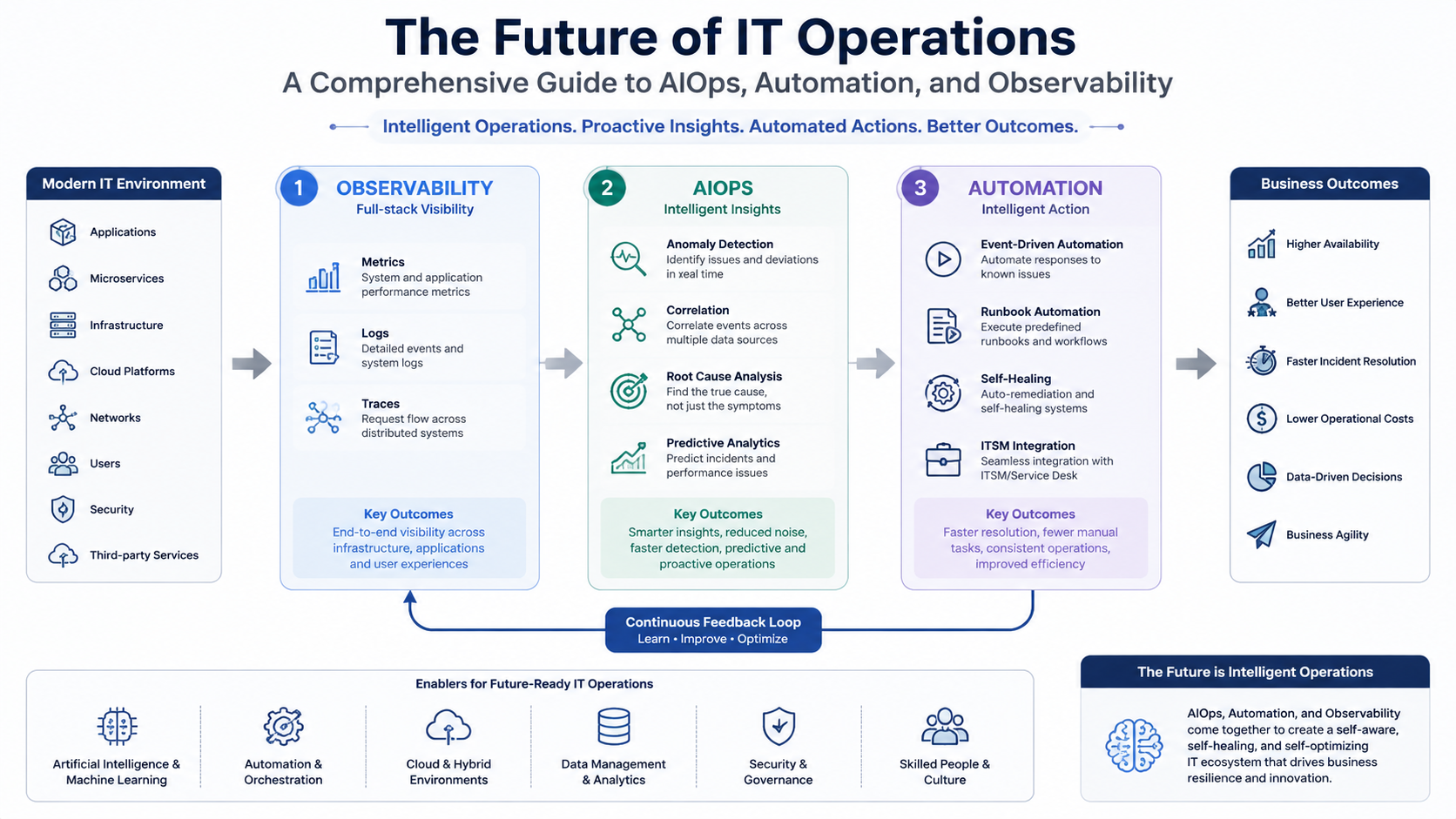
How AIOps, Automation, and Observability Work Together
These technologies are most powerful when implemented together.
Step 1: Observability Collects Data
Observability platforms continuously gather metrics, logs, and traces from IT environments.
Step 2: AIOps Analyzes Data
Machine learning algorithms analyze operational data to detect anomalies, identify patterns, and predict issues.
Step 3: Automation Takes Action
Automated workflows respond to incidents, execute remediation steps, and restore services without human intervention.
This creates a continuous operational improvement cycle that reduces downtime and improves service reliability.
Real-World AIOps Use Cases
Intelligent Incident Management
AIOps platforms correlate thousands of alerts into a single actionable incident.
Benefits include:
- Reduced alert fatigue
- Faster response times
- Improved operational efficiency
Predictive Maintenance
Machine learning models identify potential failures before they occur.
Examples include:
- Storage failures
- Network bottlenecks
- Application degradation
Automated Root Cause Analysis
AIOps solutions reduce investigation time by automatically identifying contributing factors behind incidents.
Capacity Planning
Organizations can forecast infrastructure requirements using predictive analytics.
Service Performance Optimization
AIOps continuously analyzes application performance and recommends improvements.
The Role of AIOps in Site Reliability Engineering
Site Reliability Engineering focuses on reliability, scalability, and operational excellence.
AIOps supports SRE teams by:
- Detecting anomalies faster
- Automating repetitive tasks
- Improving service reliability
- Enhancing incident management
- Reducing operational overhead
SRE teams increasingly rely on AIOps platforms to maintain complex cloud-native infrastructures.
Benefits of Adopting AIOps
Reduced Mean Time to Detect
Organizations identify issues faster through intelligent monitoring.
Reduced Mean Time to Resolve
Automated diagnostics and remediation accelerate recovery.
Improved Service Availability
Proactive issue detection minimizes downtime.
Better Customer Experience
Reliable applications lead to higher user satisfaction.
Lower Operational Costs
Automation reduces manual effort and increases efficiency.
Enhanced Operational Intelligence
Teams gain actionable insights from massive operational datasets.
Challenges Organizations Must Address
While AIOps offers significant advantages, successful implementation requires careful planning.
Data Quality Issues
Machine learning models depend on accurate and complete data.
Tool Integration Complexity
Organizations often use multiple monitoring and management platforms.
Skills Gap
Teams may require training in AI, machine learning, observability, and automation.
Cultural Transformation
Successful AIOps adoption requires collaboration across development, operations, and business teams.
Change Management
Organizations must establish governance and operational best practices for automated decision-making.
Best Practices for Implementing AIOps
Start with Observability
Build strong observability foundations before introducing AIOps capabilities.
Consolidate Operational Data
Centralize logs, metrics, traces, and events into unified platforms.
Prioritize High-Impact Use Cases
Focus initially on:
- Incident management
- Root cause analysis
- Event correlation
- Predictive monitoring
Automate Incrementally
Begin with low-risk automation workflows before expanding to more complex scenarios.
Continuously Train Models
Machine learning models require ongoing refinement to maintain accuracy.
Emerging Trends Shaping the Future of IT Operations
Generative AI for IT Operations
Generative AI is beginning to assist operators by:
- Summarizing incidents
- Generating remediation recommendations
- Creating operational documentation
- Improving knowledge management
Autonomous Operations
Future platforms will increasingly perform self-healing and self-optimizing functions.
Hyperautomation
Organizations are combining AI, automation, process mining, and analytics to create intelligent operational ecosystems.
Unified Observability Platforms
Businesses are moving toward integrated platforms that combine monitoring, observability, AIOps, and automation capabilities.
Predictive and Preventive Operations
The future of IT operations lies in preventing incidents rather than simply responding to them.
Skills Required for Future IT Operations Professionals
Professionals seeking careers in AIOps should develop expertise in:
- IT Operations
- Cloud Computing
- DevOps
- Site Reliability Engineering
- Observability
- Machine Learning Fundamentals
- Automation Frameworks
- Data Analytics
- Incident Management
- Infrastructure Monitoring
These skills will become increasingly valuable as organizations adopt intelligent operations platforms.
Why AIOps Is the Future of IT Operations
The growth of cloud computing, distributed systems, and digital services has fundamentally changed how organizations manage technology.
Traditional operational approaches can no longer keep pace with the scale and complexity of modern environments.
AIOps provides the intelligence required to analyze vast amounts of operational data. Observability delivers the visibility needed to understand complex systems. Automation enables rapid and consistent action without human intervention.
Together, these technologies create a powerful operational model that improves reliability, reduces downtime, enhances customer experiences, and lowers operational costs.