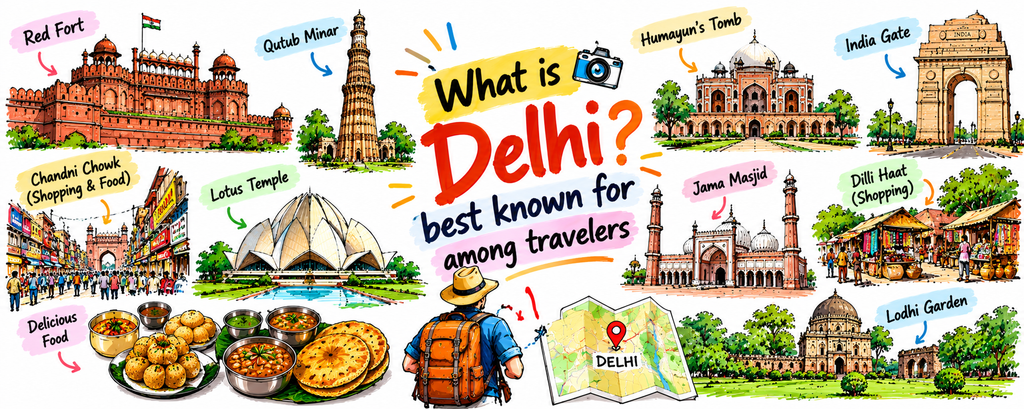
Delhi is one of India’s most diverse travel destinations.
The city brings together centuries of history, grand monuments, busy markets, religious landmarks, museums, local food, gardens, and modern city life.
For many travelers, Delhi is best known for its historic architecture and cultural diversity. The city has been shaped by different rulers and periods, including the Delhi Sultanate, Mughal era, and British period. Its monuments, streets, markets, and neighborhoods still show these different layers of history.
Delhi also offers a strong contrast between Old Delhi and New Delhi.
Old Delhi is known for narrow lanes, historic buildings, traditional markets, mosques, and street food. New Delhi has broad avenues, government buildings, museums, modern shopping areas, restaurants, and green spaces.
This combination makes Delhi interesting for travelers with different interests.
What Is Delhi Most Famous For?
Visitors usually associate Delhi with several major experiences.
| Delhi Experience | Why Travelers Know It |
|---|---|
| Historical monuments | Red Fort, Qutub Minar and Humayun’s Tomb |
| Old Delhi | Chandni Chowk, Jama Masjid and traditional markets |
| Indian history | Museums, memorials and heritage sites |
| Food | Chaat, parathas, kebabs, chole bhature and more |
| Religious places | Temples, mosques, gurdwaras and Lotus Temple |
| Shopping | Chandni Chowk, Sarojini Nagar, Dilli Haat and more |
| Government landmarks | India Gate, Rashtrapati Bhavan and Central Delhi |
| Culture | Music, theatre, art and festivals |
| Green spaces | Lodhi Garden, Sunder Nursery and other parks |
| Modern city life | Metro, malls, cafes and contemporary neighborhoods |
These experiences are spread across the city, so travelers can build very different Delhi itineraries depending on their interests.
1. Delhi Is Famous for Its Historical Monuments
History is probably the biggest reason travelers visit Delhi.
The city has monuments connected with different periods of Indian history.
Delhi Tourism identifies Qutub Minar, Red Fort, and Humayun’s Tomb as its three UNESCO World Heritage monuments.
These sites allow visitors to see different architectural traditions in one city.
Major Historical Attractions
| Monument | What Visitors Can Experience |
|---|---|
| Red Fort | Mughal architecture and history |
| Qutub Minar | Medieval Indo-Islamic architecture |
| Humayun’s Tomb | Mughal garden-tomb architecture |
| Purana Qila | Historic fort architecture |
| Safdarjung Tomb | Late Mughal architecture |
| Tughlaqabad Fort | Medieval fortifications |
| Agrasen Ki Baoli | Historic stepwell |
| Mehrauli Archaeological Park | Layers of Delhi’s history |
A traveler interested in history can spend several days exploring these sites.
2. Red Fort Is One of Delhi’s Biggest Symbols
The Red Fort is one of the landmarks most closely associated with Delhi.
The fort was built by Mughal emperor Shah Jahan in the 17th century. Its red sandstone walls and Mughal architecture make it one of the city’s most recognizable monuments.
The fort also has an important connection with modern India’s history.
Every year on Independence Day, the Prime Minister addresses the nation from the Red Fort’s ramparts. Delhi Tourism identifies the fort as a major landmark of the city and an important part of India’s national story.
Why Travelers Visit
- Mughal architecture
- Historic palace complex
- Large defensive walls
- Museums and exhibits
- Cultural history
- Photography
- Connection with India’s Independence Day
A Red Fort visit can also be combined with nearby Old Delhi attractions.
3. Qutub Minar Represents Another Chapter of Delhi’s History
Qutub Minar is another major symbol of Delhi.
The tower dates to the 12th century and represents the early Islamic architectural history of Delhi. Incredible India describes it as a towering minaret and notes its importance as a major historic landmark.
The surrounding Qutub complex contains additional historic structures.
Visitors Can Explore
- Qutub Minar
- Quwwat-ul-Islam Mosque
- Iron Pillar
- Alai Darwaza
- Historic ruins
The complex works well for travelers who enjoy architecture and archaeology.
4. Humayun’s Tomb Is Known for Its Garden Architecture
Humayun’s Tomb gives travelers another view of Mughal architecture.
The monument combines a grand tomb structure with a formal garden layout.
Incredible India describes it as a 16th-century garden mausoleum with a symmetrical design and distinctive Mughal craftsmanship.
It is particularly attractive for visitors interested in:
- Architecture
- Photography
- Gardens
- Mughal history
- Heritage walks
The monument also helps travelers understand the architectural development that later influenced other major Mughal buildings.
5. Old Delhi Is Famous for Its Lively Streets
Old Delhi offers a completely different experience from the broad avenues of New Delhi.
The area around Chandni Chowk, Jama Masjid, and Chawri Bazaar is known for busy streets, historic buildings, traditional shops, religious sites, and food.
Incredible India’s Delhi itineraries combine the Red Fort, Jama Masjid, Chawri Bazaar and other Old Delhi attractions into a heritage-focused experience.
Old Delhi Is Good for
- Heritage walks
- Street food
- Shopping
- Photography
- Architecture
- Local markets
- Cultural experiences
The area can feel crowded.
That is part of its character, but visitors should allow extra time for walking and transportation.
6. Delhi Is Famous for Its Food
Food is another major reason travelers enjoy Delhi.
The city offers a mixture of North Indian, Mughlai, Punjabi, regional Indian, and international cuisines.
Incredible India highlights Delhi’s street food culture, particularly around Chandni Chowk.
Popular Foods to Try
| Food | Where Travelers Often Look |
|---|---|
| Chaat | Old Delhi and local markets |
| Aloo tikki | Street-food areas |
| Chole bhature | Local eateries |
| Parathas | Chandni Chowk |
| Kebabs | Old Delhi |
| Biryani | Old Delhi and other food areas |
| Samosa | Markets and snack shops |
| Gol gappe | Street-food stalls |
| Butter chicken | Restaurants across Delhi |
| Jalebi | Traditional sweet shops |
Visitors can experience food at several levels.
You can try a quick street snack in a market, enjoy traditional restaurant food, or choose modern restaurants in areas such as Connaught Place and Khan Market.
7. Chandni Chowk Is a Major Food and Shopping Destination
Chandni Chowk is one of the best-known areas of Old Delhi.
The market is famous for its narrow lanes, shops, traditional food, spices, textiles, jewelry, and historic atmosphere.
Incredible India describes Chandni Chowk as an important food destination and highlights attractions such as Paranthe Wali Gali and kebab spots around the Jama Masjid area.
What Can Visitors Find?
- Traditional sweets
- Parathas
- Kebabs
- Spices
- Clothing
- Jewelry
- Religious items
- Wedding goods
- Electronics
- Local handicrafts
A walk through Chandni Chowk can easily become a half-day experience.
8. Delhi Is Known for Religious Diversity
Delhi has religious landmarks belonging to several traditions.
Visitors can see mosques, temples, gurdwaras, churches, Jain sites, and the Lotus Temple.
Incredible India highlights places including Jama Masjid, Akshardham Temple, Nizamuddin Dargah, Gurudwara Bangla Sahib, and Lotus Temple.
Important Religious Places
| Place | Associated Tradition / Experience |
|---|---|
| Jama Masjid | Islamic heritage |
| Gurudwara Bangla Sahib | Sikh tradition |
| Akshardham | Hindu temple architecture |
| Lotus Temple | Bahá’í House of Worship |
| Nizamuddin Dargah | Sufi tradition |
| Sri Digambar Jain Lal Temple | Jain heritage |
| Birla Mandir | Hindu temple |
This religious variety gives travelers a chance to see different traditions within one metropolitan area.
9. Jama Masjid Is a Major Old Delhi Landmark
Jama Masjid stands close to the Red Fort and Chandni Chowk.
It is one of India’s major historic mosques and an important example of Mughal-era architecture. Incredible India includes it among Delhi’s major heritage and spiritual attractions.
Visitors often combine:
Red Fort → Jama Masjid → Chandni Chowk
This creates a convenient Old Delhi route.
Travelers should dress respectfully and follow the site’s visitor rules.
10. Gurudwara Bangla Sahib Offers a Different Cultural Experience
Gurudwara Bangla Sahib is one of Delhi’s prominent Sikh religious sites.
Incredible India highlights its architecture and langar, the community kitchen where meals are served to visitors.
Visitors interested in culture can learn about Sikh traditions while experiencing the peaceful atmosphere of the gurdwara.
When visiting any religious place, follow local customs and instructions.
11. India Gate Represents Modern Delhi
India Gate is another landmark that travelers often associate with Delhi.
The monument stands in the central part of the city and is connected with India’s military history and remembrance.
Nearby Central Delhi also contains major government buildings and ceremonial avenues.
Delhi Tourism identifies India Gate, Rashtrapati Bhavan and other Central Delhi landmarks as important parts of the city’s architectural landscape.
Nearby Areas Include
- India Gate
- Kartavya Path
- Rashtrapati Bhavan area
- National War Memorial
- Central government buildings
This part of Delhi feels very different from Old Delhi.
12. Delhi Is Known for Museums
Delhi has many museums covering history, art, science, transportation, crafts, and culture.
The official tourism sources list several museums and cultural institutions across the city.
Museums Worth Considering
| Museum | Main Interest |
|---|---|
| National Museum | Indian history and art |
| National Rail Museum | Railway history |
| National Gallery of Modern Art | Modern Indian art |
| National Crafts Museum | Indian crafts |
| National Science Centre | Science |
| Shankar’s International Dolls Museum | Dolls and global cultures |
| Pradhanmantri Sangrahalaya | Modern Indian political history |
Visitors do not need to see every museum.
Choose one or two based on your interests.
13. Delhi Has a Strong Shopping Culture
Delhi is also well known for shopping.
The city offers traditional bazaars, street markets, handicraft centers, modern shopping districts, and malls.
Incredible India highlights markets including Chandni Chowk, Connaught Place, Lajpat Nagar, Khan Market, Sarojini Nagar, Dilli Haat, and Khari Baoli.
Shopping Guide
| Market | Known For |
|---|---|
| Chandni Chowk | Traditional goods and textiles |
| Sarojini Nagar | Affordable fashion |
| Lajpat Nagar | Clothing and accessories |
| Khan Market | Boutiques, cafes and premium shopping |
| Connaught Place | Shops, restaurants and brands |
| Dilli Haat | Handicrafts and regional products |
| Khari Baoli | Spices and dry goods |
If you enjoy bargaining, some traditional markets offer opportunities to negotiate prices.
Always check whether an item’s price is fixed before bargaining.
14. Dilli Haat Is Known for Crafts and Regional Food
Dilli Haat combines shopping and food.
Visitors can browse handicrafts from different parts of India and sample regional dishes.
Incredible India describes its food plaza as a place where visitors can explore cuisines from different Indian regions.
You Can Find
- Handicrafts
- Textiles
- Jewelry
- Home décor
- Regional specialties
- Indian cuisine
- Seasonal cultural events
It is useful for travelers who want souvenirs with a regional Indian connection.
15. Delhi Has Important Green Spaces
Delhi is not only about buildings and busy streets.
The city has gardens, parks, forests, and nature areas.
Incredible India highlights places such as Lodhi Garden, Sunder Nursery, Garden of Five Senses, and Asola Bhatti Wildlife Sanctuary.
Green Places to Consider
| Place | Good For |
|---|---|
| Lodhi Garden | Gardens and historic tombs |
| Sunder Nursery | Heritage and landscaped gardens |
| Garden of Five Senses | Relaxation and walks |
| Asola Bhatti Wildlife Sanctuary | Nature and bird watching |
| Nehru Park | Open green space |
These locations can provide a break from sightseeing in crowded areas.
16. Delhi Has a Strong Art and Cultural Scene
Delhi is also a major center for art and performance.
The city has galleries, theatres, cultural centers, music venues, and literary events.
Incredible India points to areas and institutions such as Mandi House, India Habitat Centre, National School of Drama, and National Gallery of Modern Art.
Travelers can look for:
- Theatre
- Classical music
- Dance
- Poetry
- Art exhibitions
- Film screenings
- Cultural performances
The available programs change, so visitors should check current schedules before planning an evening around a particular event.
17. Delhi Offers Both Traditional and Modern Experiences
One of Delhi’s defining travel characteristics is its contrast.
You can explore a centuries-old monument in the morning.
Then you can have coffee at a modern cafe.
You can walk through an old spice market.
Later, you can visit a contemporary art gallery.
You can eat traditional street food.
Then you can choose a modern restaurant.
Delhi Tourism describes the city as a place where ancient culture and modern metropolitan life blend together.
The Contrast Looks Like This
| Traditional Delhi | Modern Delhi |
|---|---|
| Chandni Chowk | Connaught Place |
| Red Fort | Modern commercial districts |
| Old Delhi markets | Shopping malls |
| Historic havelis | Contemporary cafes |
| Traditional food | Global restaurants |
| Heritage walks | Metro travel |
| Historic religious sites | Modern cultural spaces |
This contrast is a major part of the city’s identity as a travel destination.
18. Delhi Is a Good Base for Exploring North India
Delhi’s location also makes it useful as a starting point for wider North India travel.
Visitors often use Delhi as a base or starting point for journeys toward destinations such as Agra, Jaipur, Haridwar, Rishikesh, and other northern destinations.
However, these are separate destinations and should not be treated as part of Delhi itself.
If you have limited time, it is better to decide whether you want to explore Delhi deeply or use it mainly as a starting point.
19. How Many Days Are Suitable for Delhi?
The ideal duration depends on your interests.
| Duration | Suggested Experience |
|---|---|
| 1 day | Major highlights |
| 2 days | Old Delhi + New Delhi |
| 3 days | Heritage, food, culture and shopping |
| 4 days | More museums, gardens and markets |
| 5 days | Detailed Delhi exploration |
| 6+ days | Slow travel and additional experiences |
Incredible India currently publishes a six-day Delhi discovery itinerary, while another official itinerary presents a five-day exploration of Delhi.
For a first visit, 3–4 days gives many travelers enough time to experience the city’s main character without rushing every attraction.
20. What Should First-Time Travelers Prioritize?
You do not need to see everything.
Choose attractions according to your interests.
| If You Like… | Focus On… |
|---|---|
| History | Red Fort, Qutub Minar, Humayun’s Tomb |
| Architecture | Qutub Minar, Humayun’s Tomb, Red Fort |
| Food | Chandni Chowk and Old Delhi |
| Shopping | Chandni Chowk, Dilli Haat, Sarojini Nagar |
| Religion | Jama Masjid, Bangla Sahib, Akshardham |
| Museums | National Museum and specialist museums |
| Nature | Lodhi Garden, Sunder Nursery |
| Art | NGMA, galleries and cultural centers |
| Modern Delhi | Connaught Place and contemporary neighborhoods |
| Local culture | Old Delhi and heritage walks |
A Simple 3-Day Delhi Travel Plan
Day 1: Old Delhi
Start with the historic side of the city.
Morning
Visit the Red Fort.
Late Morning
Explore Jama Masjid.
Afternoon
Walk or take a cycle rickshaw through Chandni Chowk.
Evening
Try traditional Old Delhi food.
Main theme: Mughal history, markets and food.
Day 2: New Delhi and Central Delhi
Morning
Visit Humayun’s Tomb.
Afternoon
Explore India Gate and the Central Delhi area.
Evening
Visit Connaught Place.
Main theme: Architecture, national landmarks and modern Delhi.
Day 3: Qutub Minar, Culture and Shopping
Morning
Explore Qutub Minar.
Afternoon
Choose a museum or cultural attraction.
Evening
Visit Dilli Haat or another shopping area.
Main theme: Architecture, culture and shopping.
How Can Visitors Experience Delhi Like a Traveler?
A good Delhi trip should not become a race between monuments.
Try mixing different experiences.
Morning
Choose a historic or religious attraction.
Afternoon
Visit a museum, gallery, or indoor attraction.
Evening
Explore a market, garden, or food area.
Night
Try local cuisine or attend a cultural event.
This approach gives you a broader view of the city.
Practical Tips for Exploring Delhi
1. Group Nearby Attractions
Delhi is large.
Group places by area to reduce travel time.
2. Use the Metro
The Delhi Metro can be useful for moving between many parts of the city.
3. Start Outdoor Sightseeing Early
Morning can be more comfortable for walking and outdoor monuments.
4. Keep Extra Time for Crowded Areas
Old Delhi markets can take longer to navigate than expected.
5. Dress Respectfully at Religious Sites
Follow the rules of each place.
6. Keep Your Belongings Secure
Busy markets and transport areas require normal urban travel precautions.
7. Check Current Opening Information
Museum and monument schedules can change.
What Makes Delhi Special for Travelers?
Delhi’s appeal comes from its variety.
It is not simply a city of monuments.
It is a place where history, food, religion, shopping, art, architecture, nature, and modern urban life meet.
A traveler can explore Mughal architecture in the morning, eat street food in Old Delhi at lunch, visit a museum in the afternoon, and spend the evening in a modern market or cultural venue.
That combination gives Delhi a travel experience that is difficult to reduce to one attraction.
Quick Delhi Travel Summary
| Delhi Is Best Known For | Examples |
|---|---|
| Heritage | Red Fort, Qutub Minar, Humayun’s Tomb |
| Old Delhi | Chandni Chowk, Jama Masjid |
| Food | Chaat, parathas, kebabs, chole bhature |
| Religion | Bangla Sahib, Akshardham, Lotus Temple |
| National landmarks | India Gate, Rashtrapati Bhavan |
| Shopping | Sarojini Nagar, Dilli Haat, Chandni Chowk |
| Museums | National Museum, Rail Museum, NGMA |
| Gardens | Lodhi Garden, Sunder Nursery |
| Culture | Theatre, music, art and festivals |
| Modern life | Metro, cafes, malls and contemporary neighborhoods |
Final Thoughts
Delhi is best known among travelers for its rich history, remarkable monuments, Old Delhi atmosphere, diverse food, religious landmarks, shopping, and cultural variety.
The city offers much more than a collection of famous buildings.
Visitors can walk through Chandni Chowk, explore the Red Fort, admire Qutub Minar, relax in Lodhi Garden, visit a museum, taste local food, shop for handicrafts, and experience different religious traditions within the same trip.
The biggest attraction is the combination of old and new.
Delhi’s historic streets exist alongside modern neighborhoods. Traditional markets sit close to contemporary restaurants. Ancient monuments stand within a fast-moving metropolitan city.
For first-time travelers, focusing on heritage, food, culture, and local neighborhoods can provide a much richer experience than trying to visit every attraction.
Delhi Travel Checklist
☐ Explore the Red Fort
☐ Visit Qutub Minar
☐ See Humayun’s Tomb
☐ Walk through Old Delhi
☐ Explore Chandni Chowk
☐ Try Delhi street food
☐ Visit a religious landmark
☐ Explore India Gate and Central Delhi
☐ Visit at least one museum
☐ Shop at a local market
☐ Spend time in a garden
☐ Experience Delhi’s cultural side
☐ Use the Metro where practical
☐ Group attractions by location
☐ Check current opening information before visiting
Hashtags
#DelhiTravel · #DelhiTourism · #VisitDelhi · #DelhiTrip · #OldDelhi · #DelhiFood · #IndiaTravel · #TravelIndia