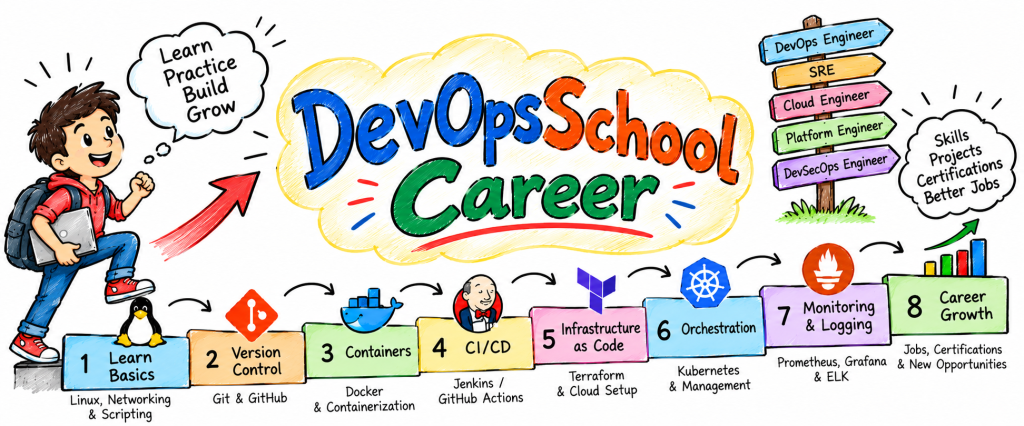
Introduction
Starting a DevOps career can feel confusing. You may see many tools, courses, and job titles.
The good news is simple. You can learn DevOps one small step at a time.
DevOps brings code, testing, servers, cloud, and automation together. Teams use these skills to deliver software and keep services running.
You do not need to learn every tool. Instead, choose skills that match your career goal.
A clear plan also saves time. It helps you know what to learn now and what to learn later.
DevOpsSchool.org offers learning paths, labs, guides, tool resources, certification information, and career content. These resources can help beginners and working professionals.
This guide gives you a simple path. It covers core skills, tools, projects, cloud, SRE, Platform Engineering, certifications, and jobs.
Know What DevOps Engineers Do
Before learning tools, understand the work. A DevOps engineer helps teams build and run software.
Developers write application code. DevOps engineers help move that code through testing and release.
They also manage servers, cloud resources, containers, pipelines, and monitoring systems.
For example, a team may need to release an app many times. A DevOps engineer can create a pipeline for that task.
The pipeline can build the code. It can also run tests and send the app to a server.
After release, the team needs to watch the app. Monitoring can show errors, slow pages, and system problems.
So, DevOps needs more than tool knowledge. You need to understand how systems work together.
Start with these basic areas:
- Linux
- Networking
- Git
- Shell scripting
- Cloud basics
- Basic security
These skills create a strong base. They also make advanced topics easier later.
Build Your First DevOps Roadmap
A DevOps roadmap should give you a clear learning order. It should also leave enough time for practice.
Begin with Linux. Learn files, users, permissions, processes, services, and basic commands.
Next, study networking. Learn IP addresses, ports, DNS, HTTP, HTTPS, and SSH.
Then learn Git. Practice commits, branches, merges, and remote repositories.
After that, learn shell scripting. Use scripts for small tasks.
Move into cloud basics next. Learn servers, storage, networking, and access control.
Then study Docker. Learn how containers package and run applications.
After Docker, learn CI/CD. Build a simple pipeline that tests and releases code.
Next, study Terraform. Use it to create cloud resources with code.
Then learn Kubernetes. Start with simple container deployments.
Finally, add monitoring, logging, security, and automation.
This order gives each skill a purpose. It also reduces the stress of learning too many tools.
Make Your Learning Path Practical
A DevOps learning path should include daily practice. Reading alone cannot teach you how systems behave.
Suppose you learn Linux today. Open a test machine and try the commands yourself.
If you learn Git, create a small project. Make changes and track them with Git.
After learning Docker, place that project inside a container. Then run and test it.
Next, create a CI/CD pipeline. Let the pipeline build and test the project.
Later, move the project to the cloud. Use Terraform to create the needed resources.
You can follow this simple cycle:
- Learn one idea.
- Try it yourself.
- Build a small task.
- Make mistakes.
- Find the cause.
- Fix the issue.
- Write down the lesson.
This method keeps your learning active. It also helps you remember skills better.
Keep a small learning journal. Write commands, errors, fixes, and useful tips.
Those notes can help during interviews. They can also become project documentation.
Follow a DevOps Engineer Roadmap by Level
Your DevOps engineer roadmap should grow with your experience. Do not study senior-level topics on your first day.
| Level | Main Learning Areas |
|---|---|
| Beginner | Linux, networking, Git |
| Junior | Cloud, Docker, CI/CD |
| Mid-level | Terraform, Kubernetes, monitoring |
| Advanced | Security, automation, reliability |
| Senior | Design, scale, cost, leadership |
Beginners should first understand servers and networks. They should also learn basic code management.
Junior engineers can start creating pipelines. They can also deploy container-based applications.
Mid-level engineers can manage infrastructure with Terraform. They can also work with Kubernetes and monitoring.
Advanced engineers need wider thinking. They must consider security, reliability, cost, and system growth.
Senior engineers often solve larger problems. They also guide technical choices and help other engineers.
Use this roadmap as a guide. Your real work may change the order.
Learn Faster With One Growing Project
One good project can teach many DevOps skills. You do not need many projects at the start.
Choose a small web application. Store its code in Git.
Next, create a Docker image. Run the app inside the container.
Then build a CI/CD pipeline. Let the pipeline test and build the application.
Move the application to a cloud server. Use Terraform to create the cloud setup.
After that, try Kubernetes. Deploy the application and manage its containers.
Add monitoring at the end. Create alerts for important problems.
Your project can grow through these steps:
- Create the application.
- Add Git.
- Add Docker.
- Add CI/CD.
- Add cloud hosting.
- Add Terraform.
- Add Kubernetes.
- Add monitoring.
- Add alerts.
- Document the work.
Each step adds a new skill. So, you can learn without starting a new project every time.
Your project can also help during job interviews. Explain the problem, your solution, your tools, and your results.
Choose DevOps Tools With a Clear Reason
There are many DevOps tools in the market. You do not need to learn all of them.
Start with the problem. Then choose a tool that can solve it.
| Area | Tools | Main Use |
|---|---|---|
| Version Control | Git | Track code changes |
| Containers | Docker | Package applications |
| CI/CD | Jenkins, GitHub Actions | Run build and release tasks |
| Infrastructure | Terraform | Create resources with code |
| Automation | Ansible | Repeat server tasks |
| Containers at Scale | Kubernetes | Manage containers |
| Monitoring | Prometheus | Collect system data |
| Dashboards | Grafana | View system data |
| Logs | ELK | Search and study logs |
Start with one tool from each area. Practice it before adding another tool.
For example, learn Docker before deep Kubernetes. Learn Terraform after you understand basic cloud resources.
Also learn how tools connect. Git can feed a pipeline. The pipeline can build a Docker image.
The pipeline can then deploy the image. Monitoring can watch the running application.
This connected view makes DevOps much easier to understand.
Connect Cloud Skills With DevOps Work
Cloud skills can support many DevOps roles. Start with one cloud platform.
First, learn virtual machines. Create a test server and connect to it.
Next, explore storage. Learn how applications store files and data.
Then study cloud networking. Learn networks, subnets, routes, and access rules.
After that, learn identity and permissions. Understand how users and services get access.
Now connect these skills with automation. Use Terraform to create your cloud setup.
Run your Docker application on the cloud. Then use CI/CD to send updates.
This hands-on method teaches several skills together. It also shows how cloud work fits into DevOps.
You can study another cloud platform later. First, build strong cloud basics.
Turn Repeated Tasks Into Automation
Automation works best when you understand the task first. Do not automate a process you do not understand.
Imagine that you need to set up ten servers. First, complete the setup on one server.
Write down each step. Then use Ansible to repeat the process.
You can follow the same idea with Terraform. First, understand the cloud resource.
Then write Terraform code to create it. Test the code before using it on larger systems.
CI/CD follows the same pattern. Understand how the team builds and tests code.
Then create a pipeline that handles those steps automatically.
Before writing automation, ask:
- Does this task repeat?
- Can code handle it?
- What can fail?
- How can I test it?
- How can I fix a bad change?
These questions help you create safer systems. They also improve your problem-solving skills.
Use an SRE Roadmap for Reliability Skills
SRE means Site Reliability Engineering. SRE teams focus on keeping services stable and useful.
A good SRE roadmap starts with core DevOps skills. Learn Linux, networking, cloud, Git, scripting, and automation.
Then learn monitoring. Study metrics, logs, dashboards, and alerts.
Next, learn incident response. Teams use this process when a service has a serious problem.
You should also learn how teams measure service health. Simple goals help teams understand system performance.
Try this small exercise. Create a simple web service and add monitoring.
Now stop the service. Watch the alert and find the cause.
Fix the service and check the result. Then write down what happened.
This exercise shows how monitoring and response work together.
Later, study automation and system design. These skills can help you handle larger systems.
Build a Platform Engineering Skill Set
Platform Engineering helps developers use shared tools and services. It aims to make common work easier.
A Platform Engineering roadmap can start with Linux, cloud, Docker, CI/CD, and Terraform.
Next, learn Kubernetes. Then explore security, automation, monitoring, and developer tools.
Imagine that many developers need the same test setup. A platform can give them one simple way to create it.
This can reduce repeated setup work. It can also help teams follow common rules.
Important areas include:
- Cloud
- Kubernetes
- Terraform
- CI/CD
- Automation
- Security
- Monitoring
- Developer tools
- Service templates
Start with one real problem. Build a small solution and test it.
Avoid adding features without a clear need. Simple platforms can often solve problems well.
Make Better Choices With DevOps Tools Comparison
A DevOps tools comparison should answer one question. Which tool fits the problem best?
Do not compare tools only by feature count. Look at how each tool works in your real setup.
| Factor | What to Check |
|---|---|
| Purpose | Does it solve the right problem? |
| Setup | Can the team start easily? |
| Learning | Can users learn it quickly? |
| Cost | Does it fit the budget? |
| Support | Can users get help? |
| Scale | Can it grow with the team? |
| Integration | Can it work with current tools? |
Suppose you need a CI/CD tool. Pick two tools for a small test.
Run the same project with both tools. Compare setup time, logs, errors, and pipeline work.
This method gives you useful real-world information. It also helps you avoid choices based only on popularity.
Choose the tool that fits your actual needs. Always test important tools before large adoption.
Plan Your DevOps Certifications Carefully
DevOps certifications can support your learning. They can also give you a clear study target.
Start with your career goal. Decide whether you want DevOps, cloud, SRE, Kubernetes, or security work.
Next, check the skills needed for that role. Then choose a certification that supports those skills.
Build your DevOps certification roadmap around practice.
Use this simple process:
- Pick your target role.
- Select one useful certification.
- Read the exam topics.
- Learn the required skills.
- Practice with labs.
- Build a related project.
- Take practice tests.
- Find weak areas.
- Review those topics.
- Prepare for the exam.
Do not collect certificates without learning the skills. Use each certification as a learning tool.
For example, study cloud networking for an exam. Then build a small network yourself.
This approach gives your study real meaning. It also gives you examples to discuss during interviews.
Prepare for DevOps Jobs With Real Projects
DevOps jobs can have different duties. One role may focus on cloud, while another may focus on automation.
Read job descriptions before planning your next skill. Write down the skills that appear often.
Then compare those skills with your current knowledge.
| Job Role | Useful Skills |
|---|---|
| DevOps Engineer | Linux, Git, cloud, CI/CD |
| Cloud Engineer | Cloud, networking, security |
| SRE | Monitoring, automation, reliability |
| Platform Engineer | Kubernetes, cloud, automation |
| DevSecOps Engineer | Security, CI/CD, cloud |
Build projects that match your target role.
For DevOps jobs, build a deployment pipeline. For SRE roles, create a monitored service.
For Platform Engineering, explore Kubernetes and developer tools. For DevSecOps, add security checks to your pipeline.
Prepare short stories about your projects. Explain the problem, your steps, the tools, and the result.
Also explain your mistakes. Show how you found the cause and fixed the issue.
Real project stories can make technical discussions much easier.
Create Content That Helps People Find Answers
Good technical content should answer real questions. It should also explain complex topics in simple words.
AEO, or Answer Engine Optimization, helps content give direct answers. Use clear questions and short answers.
GEO, or Generative Engine Optimization, helps content work well with generative search. Clear facts and useful structure matter.
LLMO, or Large Language Model Optimization, focuses on clear information for language models.
AISEO, or AI Search Optimization, focuses on content for AI search tools.
You should also understand E-E-A-T. It means Experience, Expertise, Authoritativeness, and Trustworthiness.
Useful technical content can include:
- Step-by-step guides.
- Real examples.
- Case studies.
- Research data.
- Tool comparisons.
- Expert interviews.
- Project lessons.
- Original insights.
- Practical use cases.
Keep the reader first. Explain each hard term when you introduce it.
Follow a Simple Career Growth Method
A simple framework can keep your learning on track.
Learn one topic. Understand what it does and why it matters.
Practice that topic. Use a small task to test your knowledge.
Build something useful. Solve a real problem with the skill.
Show your work. Keep your code, notes, and results clear.
Grow by taking on harder tasks. Then repeat the process.
Take Docker as an example. Learn how containers work first.
Then create an image. Run the image and test the application.
Next, connect Docker with CI/CD. After that, deploy the container to the cloud.
Finally, document your project. Explain what you built and what you learned.
You can use this method for Terraform, Kubernetes, cloud, monitoring, and security.
The framework keeps every learning step useful. It also helps you avoid random tool collecting.
Frequently Asked Questions About DevOps Career Growth
What should I learn before DevOps tools?
Start with Linux, networking, Git, and basic scripting.
These skills make cloud, Docker, CI/CD, and automation easier to learn.
Can I start a DevOps career without advanced coding?
Yes. Basic coding knowledge can help you start.
Later, learn shell scripting and Python. These skills can help you automate tasks.
Which DevOps tools should beginners learn?
Start with Git, Docker, one CI/CD tool, one cloud platform, Terraform, and monitoring.
Practice each tool through a small project.
Why should I follow a DevOps roadmap?
A roadmap gives your learning a clear order.
It also helps you avoid jumping between unrelated tools.
Do DevOps certifications help careers?
They can support your learning and career goals.
Still, combine certification study with projects and hands-on practice.
What should I learn for an SRE role?
Learn Linux, networking, cloud, monitoring, scripting, and automation.
Also learn incident response and basic reliability ideas.
What does a Platform Engineering roadmap include?
It can include cloud, Kubernetes, Terraform, CI/CD, automation, security, and monitoring.
You should also learn how platforms help developers.
How can I compare DevOps tools?
Start with the problem you need to solve.
Then compare setup, cost, learning time, support, scale, and integration.
What projects can help with DevOps jobs?
Build one project that combines several skills.
For example, use Git, Docker, CI/CD, cloud, Terraform, and monitoring together.
Where can I find structured DevOps learning resources?
DevOpsSchool.org offers learning paths, labs, guides, tool resources, certification material, and career content.
Use these resources with regular hands-on practice.
Final Thoughts
A DevOps career grows through steady practice. You do not need to learn everything in one go.
Start with Linux and networking. Add Git, scripting, cloud, Docker, and CI/CD next.
Then move toward Terraform and Kubernetes. Add monitoring, security, automation, and reliability later.
Keep building as you learn. Every project can help you understand another part of DevOps.
You can also choose a focused path. SRE, Platform Engineering, cloud, and DevSecOps each offer different areas to explore.
Certifications can support your goals when you choose them with care. Projects can show how you use those skills.
Keep your daily process simple. Learn, practice, build, test, fix, explain, and repeat.
That habit can turn a large DevOps engineer roadmap into small tasks.
DevOpsSchool.org can support your journey with learning paths, labs, technology resources, certification guidance, and career material.
Pick one skill today. Practice it well, then take the next step.